Structural Drying and Dehumidification in Fullerton, CA
Surface dry is not structure dry. The drying team dries framing, subfloor, slab and wall cavities to the IICRC S500 goal and logs the readings every day until the numbers say dry.
(888) 563-9619Describe the Fullerton damage to a local pro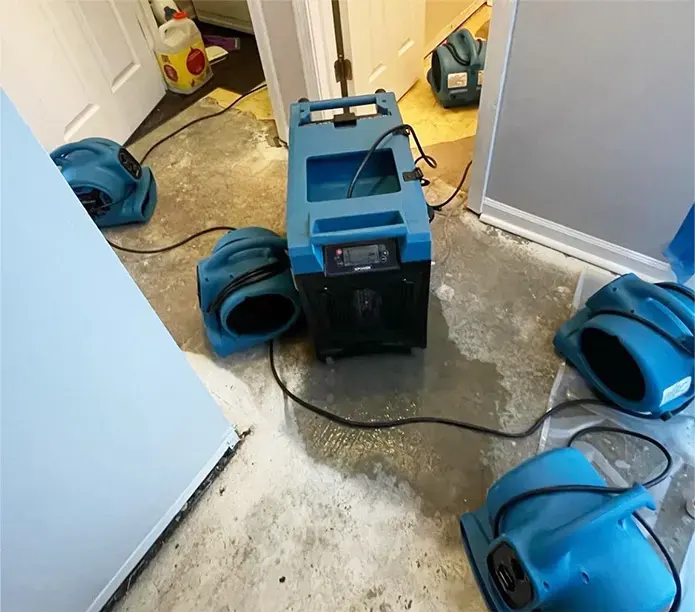
What to do the moment you find wet framing and floors
- 01Stop the water
Make sure the source is fixed or shut off.
- 02Extract first
Standing water has to come out before drying works.
- 03Keep the drying chamber closed
Leave doors and windows shut while dehumidifiers run.
- 04Leave the equipment on
Do not switch off air movers or dehumidifiers between readings.
How wet framing and floors is handled in Fullerton
The order of the work is what separates a finished dry-out from a cosmetic one.
Rapid local response
The Fullerton restoration crew works day and night and moves fast on active water, because the first hours decide how much has to come out.
IICRC S500 drying standard
The drying team maps moisture first, then dries the structure to the S500 goal, not just the surface you can see.
Claim-ready documentation
Photos before any demolition, a moisture map and daily readings go into the file an adjuster reviews.
North Orange County water experts
Galvanized lines, crawlspaces, slab leaks and unit-to-unit apartment leaks are the everyday work in Fullerton.
What does structural drying and dehumidification cost in Fullerton, CA?
In Fullerton, CA, structural drying typically runs $1,000 to $6,000 or more, depending on the class of loss, how many rooms need equipment, and whether dense materials like hardwood, plaster or concrete need desiccant drying.
Want a number for your own loss? The restoration team scopes it on site.
Price the Fullerton job by phoneClass 1 to 2
- One or two rooms
- Air movers and LGR unit
- Daily readings
Class 3
- Ceilings and walls wet
- More equipment
- Cavity drying
Class 4
- Hardwood, plaster, slab
- Desiccant dehumidifiers
- Extended monitoring
What moves the number: the class of loss, the square footage in the drying chamber, the material class (drywall versus hardwood, plaster or concrete), and how fast drying started.
For a planning range, try the Fullerton water damage cost calculator.
How wet framing and floors is dried, step by step
- 01
Map the moisture
The tech who does the walkthrough uses thermal imaging and pinless meters to find where the water went, including behind walls and under floors.
- 02
Extract the water
The extraction crew pulls standing water with truck-mounted units so it leaves the building instead of moving to the next room.
- 03
Set the drying
The drying team places air movers for the room's evaporation load and LGR dehumidifiers to pull that moisture out of the air.
- 04
Read, log, verify
Readings are logged daily, and the equipment comes out when wet materials sit within 2 to 4 points of a dry reference.
Structural drying is the part of a water loss that decides whether the problem comes back. Paint and flooring can look dry in a day, while the framing, subfloor and wall cavities behind them still hold water. The IICRC S500 is the industry drying standard, and it treats drying as a measured process, not a guess.
How a structural dry-out works
- Moisture mapping before any equipment goes down, with pinless meters, pin meters and thermal imaging
- A dry reference reading taken from unaffected material of the same type in the same building
- Air movers set to the room's evaporation load, not just pointed at the wet spot
- LGR (low grain refrigerant) dehumidifiers to pull that moisture out of the air
- Desiccant dehumidifiers for dense Class 4 materials like hardwood, plaster and concrete
- Daily readings and psychrometric logs until the drying goal is met
Fans running for days and still smells damp? Get the Fullerton drying started today, to a measured goal.
Call about Fullerton structural dryingClass 1 through 4
Class 1 through 4 sets how much equipment a room needs. Class 1 is a small area with little absorbed water, Class 2 means carpet and walls wet up to about two feet, Class 3 means water came from above and soaked ceilings and walls, and Class 4 involves dense materials that hold water tightly. Fullerton losses cover the whole range: a Class 1 appliance leak in an Amerige Heights kitchen, Class 3 when an upstairs bath soaks a ceiling in Sunny Hills, Class 4 when plaster and oak floors get wet in a Golden Hill bungalow.
Most crews compare daily readings against the dry reference. The equipment stays until wet materials sit within 2 to 4 points of that reference, not until they look dry. The EPA indoor air quality page explains why moisture control matters for a healthy home.
Fullerton's climate helps, with limits
North Orange County air is usually dry, which helps drying. Marine layer mornings and winter storms raise the humidity, and closed-up homes trap moisture, so the drying team works in a closed drying chamber with dehumidifiers rather than open windows. Slab homes need the concrete itself dried; see slab leak water damage. Water first has to come out, which is covered under water extraction. The Cal State Fullerton site is also a reminder of how many campus-area rentals share walls, where drying has to be planned unit by unit.
Equipment leaves on readings, not on a schedule
A contained Class 1 loss usually dries in three to five days; hardwood and plaster take longer. The drying log, not the calendar, decides when the air movers come out.
Structural Drying and Dehumidification across Fullerton
The Fullerton restoration crew covers every Fullerton ZIP code and the neighboring north Orange County cities, day or night.
The restoration team works across Fullerton, from Downtown and SOCO to Sunny Hills, Raymond Hills, Amerige Heights and the Cal State Fullerton area.
Coverage also reaches Anaheim, Placentia, Brea, Buena Park, La Habra, Yorba Linda and La Mirada.
See every neighborhood and ZIP codeRelated water damage services in Fullerton
Structural Drying and Dehumidification questions in Fullerton, answered
What is the IICRC S500?
It is the industry standard for professional water damage restoration. It sets how water categories and classes are handled and how drying is measured.
How do I know my house is actually dry?
Readings on the wet materials are compared with a dry reference of the same material. When they are within 2 to 4 points, the structure has met the drying goal.
Why not just open the windows?
Outdoor air is not always dry enough, and open windows let the moisture pulled from materials stay in the house. A closed chamber with dehumidifiers dries faster and more predictably.
Can I turn the equipment off at night?
Please do not. Drying depends on steady air movement and dehumidification, and stopping it lets moisture settle back into the materials.
How long does structural drying take?
Three to five days is common for a contained loss. Hardwood, plaster and concrete take longer.
Do the drying logs matter for insurance?
Yes. Daily moisture readings and psychrometric logs document that the structure was dried properly, which adjusters look for in the claim file.
Structural Drying and Dehumidification in Fullerton? Call now.
Every hour water sits, it moves further into drywall, flooring and framing. The Fullerton restoration crew extracts it, dries the structure to the IICRC S500 standard and documents the loss for the claim.